Take it offline!
This Education in Motion resource is also available as a printable PDF.
Download PDF
Sliding down in a wheelchair is a common struggle if the equipment does not match the rider's needs. We will explore the effects of sliding and examine common "quick fixes" with commentary on why those "quick fixes" often fail. In addition, we will look at how understanding the underlying causes of sliding leads to more effective solutions, including features of seating and wheelchair configuration.
Why Sliding Matters
Sliding in a wheelchair can have serious consequences:
- Poor positioning limits function and independence.
- Reduced stability affects upper extremity use. Remember: proximal stability enables distal function.
- Physiological impacts such as compromised respiration and digestion may occur due to posterior pelvic tilt.
- Skin integrity risks increase due to shear forces and potential pressure injuries.
- Increased caregiver burden arises when individuals cannot reposition themselves.
- Risk of injury and falls increase. Recall Newton's first law of motion: a body in motion stays in motion unless acted upon by a force. Without intervention, sliding may lead to falls from the wheelchair.
Common "Quick Fixes" and Why They Fall Short
Despite good intentions, many commonly used solutions don't address the root cause of sliding. These include:
Wedge cushions
Rationale: Reducing the hip-to-back angle "locks" the pelvis in place and will therefore maintain position in the wheelchair.
Why it fails: If the person has limited hip flexion, their physical ability and tolerance may be limited to maintain this position. The body compensates by sliding into posterior pelvic tilt, potentially increasing shear and discomfort.
Elevating leg rests
Rationale: Raised legs "block" sliding and will keep the pelvis positioned.
Why it fails: Stretching tight hamstrings by elevating the legs pulls the pelvis into posterior tilt, increasing the likelihood of sliding.
Medial thigh support "pommel"
Rationale: Acts as a barrier to prevent sliding off the cushion.
Why it fails: A medial thigh support doesn't prevent sliding; it simply stops the motion once it's already happening. This can be uncomfortable and ineffective. Medial thigh support/abductor wedges should be used for alignment of the lower extremities, not as a sliding deterrent.
Non-slip mats
Rationale: Friction prevents movement.
Why it fails: This is a bandage solution that does not address the cause. It may also interfere with the cushion and its cover's pressure-relieving properties, which rely on direct contact for shear management, immersion, and envelopment.
Pelvic positioning belts
Rationale: Holds the person in place.
Why it fails: If the underlying cause of sliding isn't addressed, the person may slide under or into the belt, increasing injury risk. Belts should be used to stabilize the pelvis along with optimal seating and wheelchair configuration to meet the individual's needs, not as a primary solution to prevent sliding.
Now that there is a clearer understanding of the harmful effects of sliding in wheelchairs, why quick fixes often fail, and the importance of addressing the underlying causes of sliding, we will explore equipment and musculoskeletal factors that contribute to sliding and how understanding these can guide us toward true, lasting solutions for optimal seating and wheelchair configurations, which can help prevent sliding.
Equipment-Related Causes of Sliding
Sliding can often be traced back to how the wheelchair is set up and could be a result of mismatched body shape and equipment. Common equipment-related factors include:
Improper initial positioning in the wheelchair
Even if a wheelchair and seating system is well-configured, a poor transfer (mechanical or manual) resulting in improper initial positioning can negate the benefits of the setup. For example:
- Improper alignment can result in inadequate support and a higher likelihood of sliding.
- Discomofrt from poor positioning may cause the person to shift forward in search of relief.
Arm and footrest adjustments
Simple adjustments can make a big difference for optimal positioning:
- Armrests too low: The person may slide forward to bring their arms to a supportive height.
- Footrests too low: The person may slide forward to properly support and load their feet.
Seat and backrest fit
Incorrect sizing can lead to discomfort and sliding:
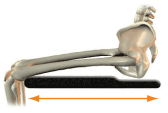
- Seat too long: When the person can't sit back all the way in their seating system because the front edge of the cushion hits the back of their knees, they will be forced to slide forward into posterior tilt.
- Trunk laterals or seat width too narrow: The person may rotate and slide to achieve a more comfortable fit.
- Trunk laterals or seat width too wide: The person may shift their pelvis and trunk to the side to gain stability and then rest in an asymmetrical posture.
- Backrest too tall or vertical: The person may slide forward to prevent falling forward.
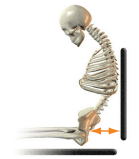
- Backrest too short: The person may slide forward to gain support where it is needed
- Equipment misalignment: Assess the equipment to ensure proper setup and verify the correct installation and alignment of all components. The backrest could have slipped, putting it in a different alignment. Is the seat cushion in the correct orientation, or is it backwards?
Seat height and improper configuration
For people who foot propel:
- Seat too high: They may scoot forward to achieve proper heel contact with the floor.
- Improper configuration: If the front casters are overloaded (person's center of mass is in front of the rear wheels, putting more weight on the casters), the rolling resistance will be increased, making propulsion more difficult. This can lead to sliding to accommodate the increased effort required.
Musculoskeletal Factors
Sliding can also result from physical conditions, such as postural asymmetries, weakness, decreased range of motion, abnormal muscle tone, and pain. Common musculoskeletal factors include:
- Posterior pelvic tilt and kyphosis: If the wheelchair setup doesn't accommodate or correct these postures, depending on whether the postural asymmetries are reducible or non-reducible, gravity will cause the person to slide.
- Limited hip range of motion: If a person can't tolerate the given seat-to-back angle, they may slide into a posterior pelvic tilt to accommodate and increase comfort.
- Limited knee range of motion: If the front hanger angle doesn't accommodate limited knee motion, the person may slide to reduce the knee angle to keep their feet supported.
- Tight hamstrings: Hamstrings attach to the pelvis and back of the knee. If the knees are extended beyond what's comfortable (e.g., with 60-70° hangers), the pelvis tilts posteriorly to reduce the stretch, leading to sliding.
- Weakness: If the person is unable to overcome gravity due to generalized weakness and/or low muscle tone, they may assume a collapsed posture and/or begin to slide forward or assume asymmetrical postures to assist with stabilizing themselves (tuck their elbow inside/on laterals, prop hands on thighs or seat, cross legs).
- Extensor tone: Increased extensor tone causes the hip and/or knees to push into extension. As the person extends against the backrest, the pelvis often slides forward on the cushion, leading to a posterior pelvic tilt.
- Pain: Some postures may be assumed to relieve pain or redistribute pressure. Assessment to determine the root cause of pain and what relieves it is crucial.
Often, more than one factor is at play. For example, someone may have both a limited hip range of motion and tight hamstrings. In such cases, multiple solutions are needed to address the root causes.
Seating and Configuration Strategies
We will now explore how seating features and wheelchair configuration can help prevent sliding when tailored to the individual's clinical presentation. Before making seating decisions, a hands-on assessment is essential. This helps identify reducible or non-reducible postural asymmetries and guides the selection of appropriate seating and wheelchair configuration.
Seating contours & materials: supporting the pelvis and spine
- Cushion contours: A cushion with a pelvic loading area (PLA) or "well" can help anchor the pelvis. If the PLA is the appropriate size and in the proper location, it stabilizes the pelvis by accommodating the height difference between the ischial tuberosities and femurs.
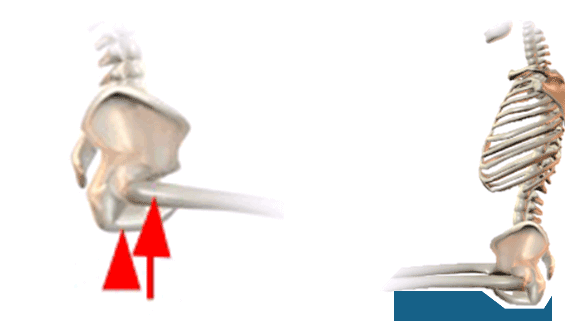
- Pressure-relieving materials (air, fluid) in the pelvic loading area can protect the ischial tuberosities and sacrum.
- Firmer surfaces (foam) under the femurs provide stability.
- Back support contours: Shaped back supports (e.g., custom, wedges, or foam inserts to accommodate spinal curves) help align and support the spine. Proper alignment reduces the risk of sliding and improves pressure distribution and comfort. Moving the back support down and ensuring contact with the posterior superior iliac spine (PSIS) to provide additional support to the posterior pelvis may assist in preventing the pelvis from rotating posteriorly.
Cushion and cover materials: managing shear and friction
Material selection matters:
- Low shear materials: Fluid, gel, air
- Higher friction materials: Foam
- Cover types: Material selection can impact positioning and skin integrity. Each material has different properties to address varying goals. For example, four-way stretch covers move with the individual to reduce friction and shear forces, but may increase sliding if positioning supports are not adequate. Microclimatic covers are designed to manage heat and moisture to improve skin microclimate, but also will have more friction (which can help reduce sliding), but may increase shear if movement occurs. Know the goal of your cover choice. Is it to prevent sliding, provide air flow, or move with the individual to reduce friction and shear?
- Clothing materials: Do they interact well with the cushion to reduce sliding?
Material alone won't prevent sliding. It must be considered alongside immersion, envelopment, and other seating factors.
Angle considerations: respecting range of motion
Sometimes a combination of seating and wheelchair configuration is employed to achieve the required angles for an individual.
- Hip angle: If a person can't tolerate the desired hip flexion, don't force it. Instead, accommodate the limitation and look at:
- Wheelchair configuration: Open back canes to accommodate the hip angle.
- Seating system modification: Adjust the back support hardware or modify cushion:
- Anterior slope: Opens hip angles bilaterally.
- Trough cut-out: Accommodates unilateral hip extension contractures.
- Knee angle and front rigging: Select the correct hanger angle based on the knee range of motion and desired foot placement:
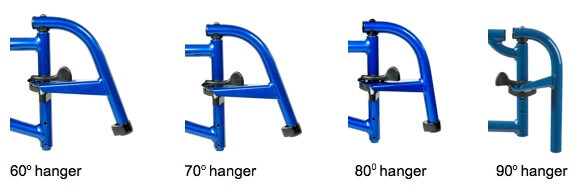
- Standard options typically include 60°, 70°, 80°, and 90° hangers. 80-90° angle allows the feet to be closer tucked, whereas 60-70° will allow for more knee extension. Both will impact the overall wheelchair footprint.
- Contracture rigging may be needed for severe limitations, allowing one or both feet to be positioned under the chair.
- Elevating leg supports may be required for significant limitations, allowing knees to rest in more extension.
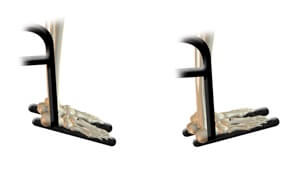
- Foot positioning: Consider using angle-adjustable footplates to respect ankle range of motion and ensure proper foot loading. A 90° ankle angle is not always ideal; adjust as needed.
Using gravity: tilt for positioning
Tilt-in-space (dynamic or fixed tilt) wheelchairs can use gravity to assist with positioning. However, tilt alone will not prevent sliding if the root cause is not addressed. Tilt should be used in combination with proper seating and configuration to be effective.
Dynamic components
Dynamic back canes can reduce sliding by allowing the back support to move backwards with the person when they exhibit extensor tone. When the back canes absorb the forces applied, the pelvis can stay better positioned at the rear of the cushion and maintain posture.
Positioning belts: final step, not first
A positioning belt should only be used after seating and configuration have been optimized. If used prematurely as a "quick fix," it won't prevent sliding and may increase injury risk. The belt's true purpose is to secure the pelvis once optimal positioning has been achieved. Adjusting the angle may provide a better point of control.
Final Thoughts
Sliding can be prevent not with bandage solutions, but by understanding the cause and addressing it through appropriate assessment, seating, and wheelchair configuration. Once the cause is known, we can tailor the setup to meet the individual's needs and minimize the risk of sliding.
References
- Lange, M.L., & Minkel, J.L. (Eds.). (2024). Seating and Wheeled Mobility: A Clinical Resource Guide (2nd ed.). Routledge. https://doi.org/10.4324/9781003526377